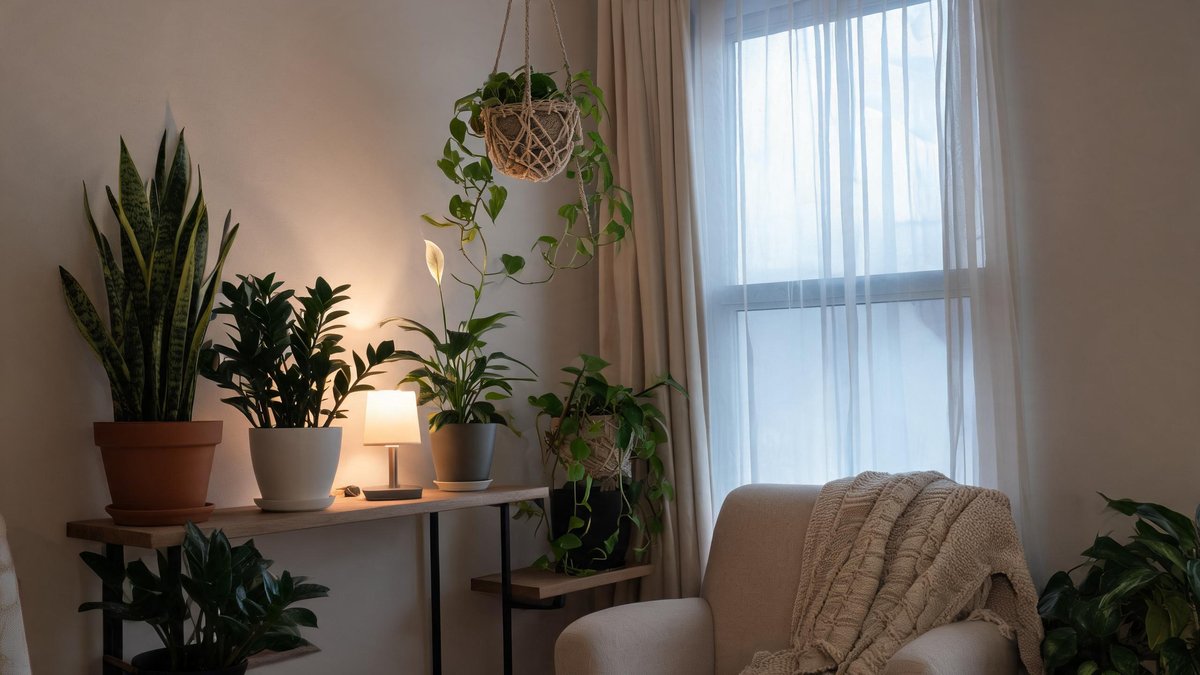
You want indoor greenery but your apartment gets little natural light. Maybe your windows face a brick wall or your office cubicle feels like a cave. The good news: plenty of houseplants don't just tolerate low light — they actually thrive in it. And they're tough enough to survive a missed watering or two. Here's your guide to the best low-light houseplants that are hard to kill, plus the care tricks that keep them looking lush for years.
What “Low Light” Actually Means (Don’t Rely on Your Eyes)
Your eyes are terrible light meters. They adapt so quickly to dimness that a room might feel bright to you while offering almost nothing usable to a plant. Low light doesn't mean zero light — it usually means a spot more than 6 feet from a north-facing window or a corner that receives no direct sun. University of Minnesota Extension points out that many low-light plants need only 50 to 100 foot-candles for 12 hours a day. To put that in perspective, a reading lamp at arm's length might deliver about 100 foot-candles, while a bright office can top 500.
You can measure the light yourself with a free smartphone app like Lux Light Meter. Aim for at least 50 foot-candles in the darkest part of the day. If you don't measure, watch your plant: stretching stems, small new leaves, and a general “leggy” look signal it's craving more photons. The fix is often simpler than you think — just slide the pot 2 feet closer to a window or rotate it weekly so all sides get a chance. Your plant will tell you if it's happy.
5 Hard-to-Kill Houseplants That Thrive in Dim Corners
Not all low-light survivors are created equal. These five have decades of proof behind them — and you'll find them at almost any garden center.
Design Tip: A programmable timer on outdoor lighting saves up to 50% on landscape lighting electricity. Solar path lights are a zero-cost alternative that require no wiring.
Snake Plant (Sansevieria) — This upright succulent handles light levels as low as 20 foot-candles without complaining. A NASA Clean Air Study found it removes benzene and formaldehyde from indoor air. It stores water in its thick leaves, so you'll water it maybe once a month. Overwatering is the only real threat.
ZZ Plant (Zamioculcas zamiifolia) — With glossy, almost plastic-like foliage, the ZZ can go 4 to 6 weeks without water and still look good. It thrives in 50-foot-candle conditions and actually performs better when you forget it exists. Its potato-like rhizomes hold moisture, making it a dream for travelers.
Pothos (Epipremnum aureum) — The poster child for easy care. You can grow pothos in a vase of water alone, though soil is better long-term. It reduces airborne mold spores by up to 60% in enclosed spaces, according to research by the American Society for Horticultural Science. Golden pothos, marble queen, neon — all do well in low light, though variegated types may fade if it's too dark.
Heartleaf Philodendron (Philodendron hederaceum) — Similar to pothos but with softer, heart-shaped leaves, this plant has been a parlor staple since the Victorian era. It'll survive a light level of 50 foot-candles and occasional drought. Prune it back when stems get too long and you'll have a bushy companion for years.
Cast Iron Plant (Aspidistra elatior) — The name says it all. It tolerates temperatures from 45°F to 85°F and deep shade that would kill most plants. While growth is slow, a mature cast iron plant can live 25 years or more with minimal attention. Dust the leaves once a month to keep its deep green color shining.
The practical takeaway here is simple: pick one or two of these, and place them where you'll actually see them. You're more likely to notice when they need water if they're in your daily line of sight.
The Real Reason Most Houseplants Die (Hint: It’s Not the Light)
Overwatering kills far more houseplants than darkness ever will. Researchers at the University of Florida found that overwatering accounts for 80% of houseplant deaths. It's not the water itself but the lack of oxygen — when soil stays soggy, roots suffocate and rot sets in. In low light, the problem compounds because plants use even less water. You water once a week out of habit, but the plant hasn't dried out at all.
Get into the “soak and dry” rhythm. Stick your finger 2 inches into the soil. If it feels even slightly damp, don't water. When you do water, thoroughly drench the pot until water runs from the drainage holes, then let the excess drain completely. For a snake plant in a 6-inch pot, that might mean watering every 3 to 4 weeks in winter. For a pothos in a brighter low-light spot, maybe every 10 days. You'll learn your plant's personal schedule, and it'll reward you by not dropping yellow leaves.
Never let a plant sit in a saucer full of water for more than 30 minutes. And if you're really unsure, a $12 moisture meter will give you a clear answer. That small investment can save dozens of plants.
Container and Soil Choices That Keep Roots Happy for Years
The pot and soil you choose directly affect how long your plant lives. Terra cotta pots wick moisture away from the roots, which is perfect for low-light plants that don't dry out quickly. Plastic or glazed ceramic pots hold water longer, so you'll need to be extra careful with watering. A Cornell University study noted that compacted soil can reduce root growth by up to 40% — that's a huge setback for a plant already dealing with limited light.
You want a potting mix that drains fast but retains just enough moisture. A blend of 2 parts standard potting soil, 1 part perlite, and 1 part orchid bark works wonders. If you don't want to mix your own, use a cactus and succulent mix straight from the bag — it's lighter and grittier. Avoid garden soil at all costs; it compacts in containers and brings pests indoors.
When you pot up, pick a container only 1 to 2 inches wider than the root ball. An oversized pot holds excess soil that stays wet too long, drowning roots. And no matter how lovely that cachepot is, the inner pot must have drainage holes. Without an escape route, water collects at the bottom and creates a stagnant swamp. Your hard-to-kill plant won't survive that.
Simple Pest Prevention Without Harsh Chemicals
Even resilient plants attract pests when they're stressed. Low light, overwatering, and dry indoor air make spider mites, mealybugs, and fungus gnats more likely. The Royal Horticultural Society reports that regularly wiping leaves can cut pest populations by 50% or more — a prevention habit that takes only minutes.
Once a month, give your plants a lukewarm shower in the bathtub. This rinses dust off leaves, dislodges any early pests, and raises humidity for a few days. Dust blocks light absorption, so you're actually increasing photosynthesis with every wipe. For plants that can't be moved, use a damp microfiber cloth and gently clean both the top and underside of each leaf.
Quarantine any new plant for two weeks before placing it near your existing collection. Inspect it every few days for webbing, white fluff, or tiny flying insects. If you do spot a problem, a mix of 1 teaspoon neem oil, a few drops of mild dish soap, and a quart of water sprayed on the leaves usually handles it. Repeat once a week for three weeks. You'll break the pest life cycle without filling your home with toxic chemicals.
When (and How) to Repot Without Stressing the Plant
Most low-light houseplants prefer being slightly root-bound. Their growth slows in dim light anyway, so they don't exhaust soil as quickly as sun-lovers. Repotting too often disturbs the roots and can stall growth for months. A study from the University of Georgia found that moving a plant into a container more than 2 inches larger than its root ball doubles the risk of overwatering — the extra soil holds moisture the roots can't reach.
Repot only when you see roots circling the bottom of the pot or poking through drainage holes, which typically happens every 2 to 3 years. Choose a pot one size up, gently tease the roots apart if they're tightly wrapped, and use the same well-draining mix. After repotting, water lightly and place the plant back in its original spot for a few weeks so it doesn't face a light change while it settles. Hold off on fertilizer for at least a month — fresh soil provides enough nutrients, and weak roots burn easily.
If you've inherited a plant that's been in the same pot for 5 years, repot it in spring when days start to lengthen. That timing helps it recover faster. And if you're unsure, it's safer to wait another season than to repot prematurely. These plants forgive neglect; they don't forgive overcare.