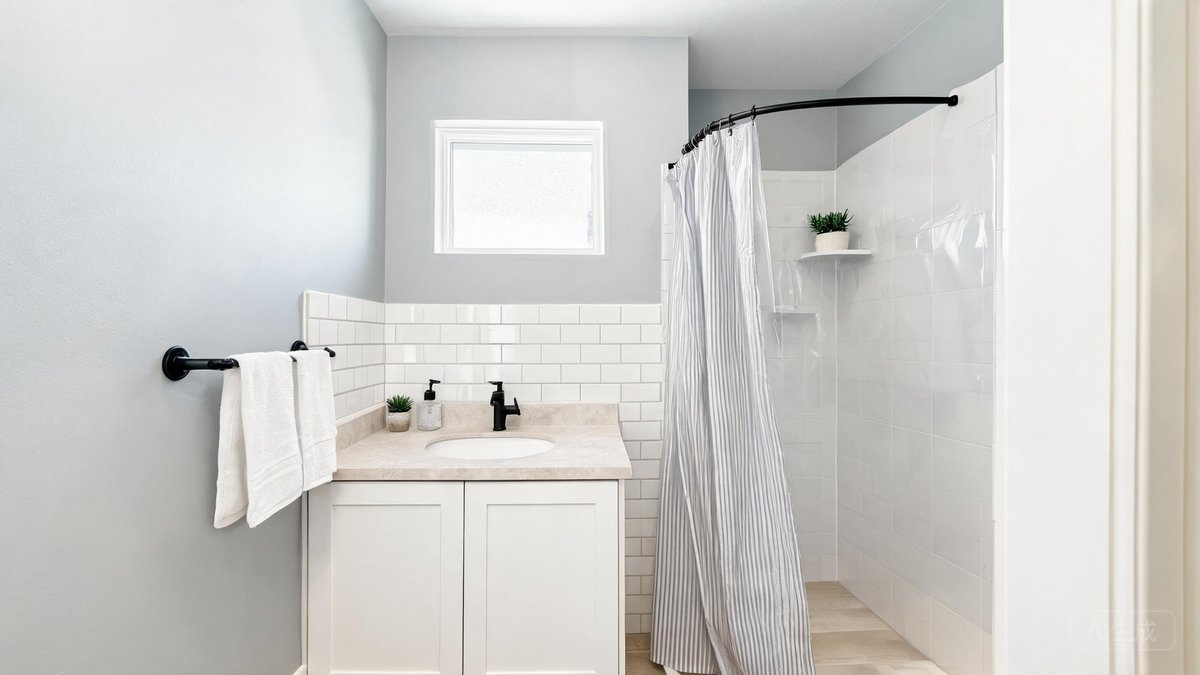
A full bathroom remodel averages $11,000 in 2026 according to the National Kitchen and Bath Association — and that number climbs to $25,000 or more for a master bath. You do not need to spend anything close to that to transform your bathroom. With $500 and a weekend of work, you can replace the features that visually date a bathroom and address the worn-out surfaces that make it feel dirty even when it is clean. Here are the projects that deliver the biggest impact per dollar spent.
Paint and Color: The Cheapest Transformation in the Room
Paint covers more square footage per dollar than any other bathroom material. A gallon of premium bathroom paint — formulated with mildewcides and a satin or semi-gloss finish that handles humidity — costs $35 to $55. That single gallon covers the walls of a standard 5-by-8-foot bathroom with two coats. You spend $50 and change the color temperature of the entire room in an afternoon.
Color choice matters more in bathrooms than in other rooms because bathrooms are small enclosed boxes. Dark colors — navy, charcoal, deep green — make a powder room feel dramatic and intimate, especially when paired with bright white trim and a large mirror. Light colors — warm whites, pale blues, soft sage — make a small bathroom feel larger by reflecting more of whatever light you have. Avoid pure white on walls in windowless bathrooms; it turns gray and cold under artificial light. Choose a white with warm undertones like Benjamin Moore Swiss Coffee or Sherwin-Williams Alabaster instead.
Prep work is non-negotiable. Bathroom walls collect a film of hairspray, lotion residue, and soap scum that paint cannot bond to. Wash every wall with a TSP solution or a dedicated deglosser, rinse with clean water, and let it dry completely before you open the paint can. Tape the edges of the tub, vanity, and mirror, and lay drop cloths across the floor and fixtures. A bathroom takes 45 minutes to prep and 30 minutes to paint per coat. Skipping the prep means peeling paint within a year.
Hardware Swaps That Feel Like a New Bathroom
Builder-grade bathroom hardware — the chrome towel bar, the plastic toilet paper holder, the generic faucet — signals "rental apartment" even in a $400,000 house. Replacing every visible piece of hardware in a standard bathroom costs $100 to $200 and takes a few hours with basic tools.
Design Tip: A 2023 Houzz survey found that 40% of homeowners plan garden upgrades each year. Even a $200 investment in perennials and mulch increases curb appeal measurably.
Start with the faucet. A single-handle widespread faucet in brushed nickel or matte black instantly updates a vanity that still has a two-handle chrome model from 2003. Faucets in the $60 to $120 range from brands like Delta and Moen include ceramic disc cartridges that will not drip after two years, unlike the plastic cartridges in $30 faucets. Match the finish to your other hardware: if you choose brushed nickel for the faucet, use brushed nickel for the towel bar, robe hooks, and toilet paper holder.
The showerhead is the easiest swap in the room. Unscrew the old one by hand or with an adjustable wrench, wrap the threads with plumber's tape, and screw on the new one. A rainfall showerhead with adjustable spray patterns costs $30 to $80 and changes how your shower feels every single morning. No plumbing skills required — the pipe in the wall stays exactly where it is. While you are at it, replace the shower curtain rod with a curved model that bows outward, adding 6 to 8 inches of elbow room inside the shower. That is a $25 upgrade that makes a standard tub feel like a walk-in.
Lighting Upgrades for Under $50
Most bathrooms have a single overhead fixture that casts harsh shadows downward, making everyone look tired and the room feel smaller. A proper bathroom lighting setup layers two types of light: ambient from the ceiling and task lighting around the mirror.
Replace the overhead fixture with a flush-mount LED that outputs 1,500 to 2,000 lumens in a color temperature of 3,000K to 3,500K. This is warm enough to feel natural but cool enough to provide useful illumination for shaving or makeup. A quality flush-mount fixture costs $35 to $50 at home centers and installs with three wire nuts. Turn off the breaker first — bathroom circuits are often shared with other rooms, so test the wires with a non-contact voltage tester even after you think the power is off.
For task lighting, add a pair of vertical sconces on either side of the mirror at roughly eye level, or install an LED light bar above the mirror. Side lighting eliminates the under-eye shadows that overhead lights create. If rewiring is not in your budget or skill set, use plug-in sconces with cord covers painted to match the wall. They cost $30 to $40 each and look nearly indistinguishable from hardwired fixtures once the cord cover is painted.
Vanity Refresh Without Replacing the Cabinet
A new vanity costs $300 to $900 before installation. You can refresh the one you have for $60 to $120 and keep the cabinet structure intact. If the cabinet face is wood — even builder-grade oak — sand it lightly with 220-grit sandpaper, prime it with a bonding primer, and paint it with cabinet-grade enamel. A dark navy or charcoal vanity against light walls creates a focal point that looks custom-designed. New hardware — two pulls and two knobs — costs $20 to $40 total and completes the transformation.
If the vanity top is cultured marble or laminate in a color that screams 1990s, but the cabinet underneath is solid, consider replacing only the countertop. Pre-fabricated vanity tops in quartz or granite with an integrated sink cost $150 to $250 at home centers and drop directly onto the existing cabinet. Measure your cabinet width to the nearest inch before shopping. A top that is half an inch too wide can be scribed to fit; one that is half an inch too narrow leaves a gap that collects water.
If the vanity itself is particleboard that is swelling at the base from water damage, do not invest in painting or a new top. That cabinet is failing structurally and will only get worse. Put your money toward a replacement instead, even if it means delaying other upgrades.
Caulk, Grout, and the Details People Notice
Fresh white caulk along the tub, around the sink, and at the base of the toilet makes a bathroom look cleaner than any other $10 fix. Old caulk turns yellow, cracks, and harbors mildew in the gaps. Remove the old bead with a utility knife and a caulk remover tool, clean the joint with rubbing alcohol, and apply a new bead of silicone caulk labeled for kitchen and bath use. Dip your finger in soapy water and run it along the bead in one smooth motion to tool it flat. Let it cure for 24 hours before exposing it to water.
Swap the toilet seat while you are working on the small stuff. A soft-close, quick-release seat in white costs $30 to $50 and eliminates the clatter of a dropping lid. It takes five minutes to install with two bolts. While you are at floor level, replace the old vinyl or rubber toilet supply line with a braided stainless steel one — it costs $8 and will not burst like the old rubber lines eventually do. Water damage from a burst supply line is one of the most common insurance claims in American homes.
What to Save for When $500 Is Not Enough
A $500 budget covers surface-level improvements brilliantly — the things you see and touch every day. It does not cover structural changes: moving plumbing, replacing a tub, retiling a shower surround, or addressing water damage behind walls. Those projects require permits, licensed tradespeople, and budgets that start at $5,000 and go up from there.
If your bathroom has a leaking shower pan, a rotted subfloor around the toilet, or a tub that has rusted through its enamel coating, surface upgrades will not fix the underlying problem. In those cases, save your $500 toward the necessary repair. A fresh coat of paint on a wall with a water-damaged stud behind it is money thrown away. Prioritize the projects that prevent further damage before the projects that improve appearance. The fresh caulk and new faucet can wait until next month; the toilet that wobbles because the flange is cracked cannot.